
The Current Sawyer County Owner Record
The public route to the tax-roll owner-of-record clue runs through Novus. County instructions confirm the search keys. They also explain how a selected parcel behaves. But they stop short of documenting every live field on the parcel card. Some answers must come from the parcel result itself. Others must come from the recorded deed.
| Owner name | The assessment roll's owner-of-record lead; exact live card label was not captured. |
|---|---|
| Mailing address | Tax-bill destination maintained by Land Records; not proof of occupancy. |
| Site address | Novus search field labeled Site Address (Fire Number). |
| Tax ID | Confirmed search key and useful join across roll, map, and deed. |
| Vesting terms | Read the recorded deed; the static Novus guide does not list this card field. |
| Latest deed | Confirm through the Register of Deeds index and image. |
An owner of record is simply the name tied to the tax parcel. It is not a label for who lives there. The site address locates the land. A mailing address tells where a tax bill goes. A trust, LLC, or estate can appear as the roll name. A freshly recorded deed can also be newer than the assessment entry, so compare both.
How Current Is the Sawyer County Owner Roll?
Sawyer County describes its Novus assessment data as dynamic. It is subject to maintenance, correction, and update. No standard waiting period between a closing and a roll change is published. Date any tax record when you pull it. This matters particularly after a sale or a mailing-address change.
For the latest transfer date, compare the roll with the most recent recorded deed. Do not guess from a normal posting interval. Save the tax ID and retrieval date with your printout. Then note any deed recorded after that date. The county documents no guaranteed nightly or weekly sync among the assessment portal, deed index, and map. So a mismatch between systems needs custodian confirmation.
A current ownership question works in two steps. Read the roll first. Then compare it with the newest recorded conveyance. If the deed is more recent, the instrument is the stronger clue to the present transfer. Verification here concerns the latest vesting; a former-owner search traces the chain backward instead.
The county's Novus portal is the public entry point for the roll.
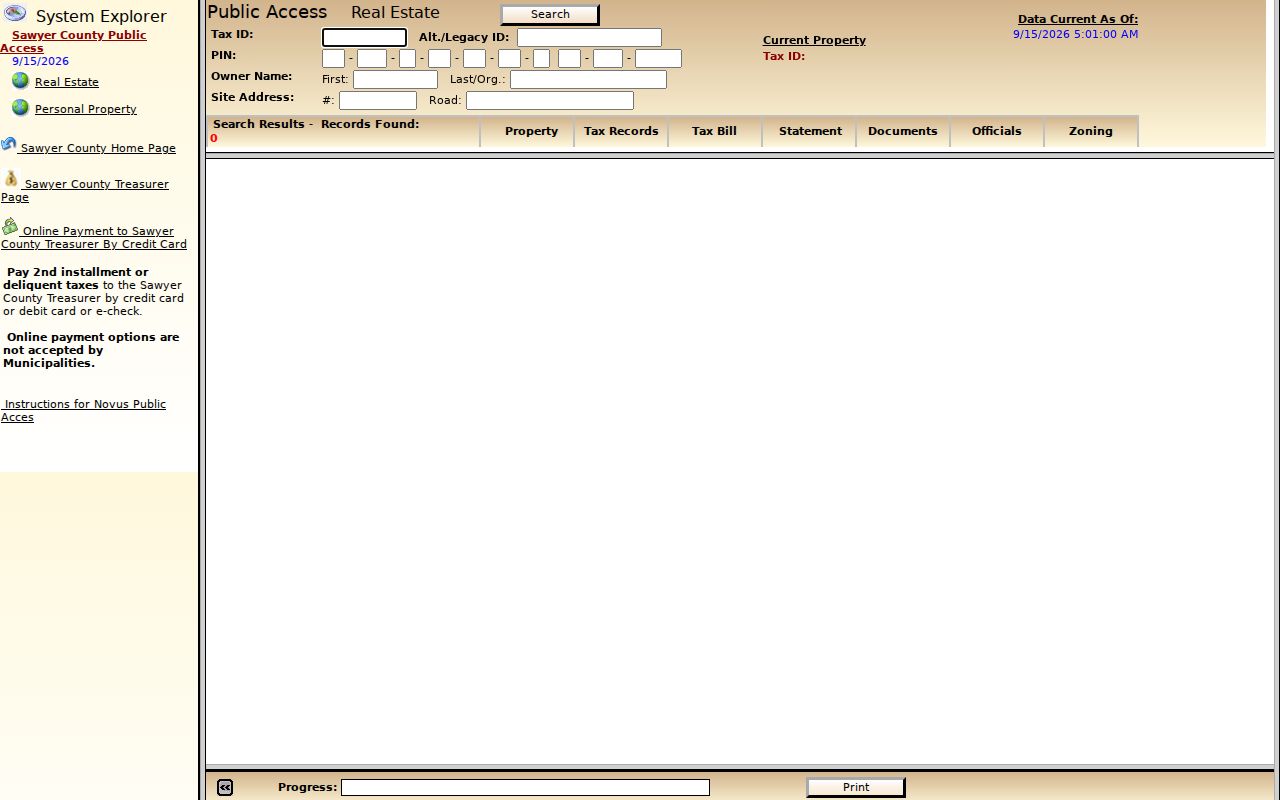
The portal screen shows the parcel search start; the county promises no fixed roll-refresh interval.
Site, Mailing, and Legal Addresses in Sawyer County
"Site Address (Fire Number)" is the Novus key for where a parcel sits. A mailing address routes tax notices. It may be a post-office box, a second home, or another valid destination. The legal description defines the land in the instrument itself. Keep those three roles separate when confirming the current owner.
Sawyer County Land Records updates tax-bill mailing addresses. County tax guidance names November 15 as the cutoff for the next bill cycle. A postal city or ZIP alone cannot settle municipal jurisdiction. Compare the parcel code and the county map too.
Confirm the Newest Sawyer County Deed
The latest recorded deed names the grantee and the terms of transfer. Match its legal description to the parcel. Watch for later correction deeds or related instruments. An index entry can locate the image. Only the image shows whether the grantee is an individual, spouses, a trustee, or an entity.
Sawyer County deed images start in 1883, with online name indexing from December 1919. That coverage matters when a parcel's newest transfer is not visible online. Ask the Register of Deeds for a counter search instead of declaring the owner unknown. Copy and index routes are detailed on the Sawyer County deed-records page.
Occasional searches run through Tapestry at $6.95 per search plus $1 per image page. Frequent users can ask the Register about Laredo access. Counter service is open during posted weekday hours. The notice for instrument 201448 shows that some images require contacting the office. That applies when no portal result appears. Confirm fees and access terms before ordering a copy.
Recent closing. The county gives no fixed assessor-roll update interval. When a closing is newer than the roll entry, verify the grantee in the newest recorded deed.
Verify the Sawyer County Current Owner
Use the assessment roll for the present tax owner. Then use the recorded instrument to check the vesting. A clean cross-check means matching the same parcel, not a similar name or street. The owner field may hold a company or fiduciary, and the situs and mailing addresses can point to different places.
- Search the parcel in Novus and note the tax ID, owner clue, and site address.
- Search the latest deed in Tapestry or Laredo and open the image.
- Compare the named grantee and legal description with the same parcel.
- Use DFI only to interpret a business entity filing, not to substitute for the deed.
- Owner of record
- The name tied to a parcel on the assessment roll.
- Vesting
- The deed language that states how the grantee takes the interest.
- Registered agent
- A business filing contact; not necessarily an owner or occupant.
- Recording lag
- The time between a deed recording and its appearance in another system; Sawyer gives no fixed interval.
A name on an instrument may describe joint owners, a trustee, a personal representative, or a business entity. Read how the deed states the grantee and the type of interest. Don't shrink the result to one personal name. A corporate filing can clarify an LLC's identity. Yet it will not name every beneficial owner. A probate file explains authority but does not itself convey the land.
The 236 Prefix and Sawyer County Owner Roll
The first three digits of a parcel number tell you the municipality. A City of Hayward parcel opens with 236. A Town of Hayward parcel opens with 010. Both can carry a Hayward mailing address, yet each falls under a different municipal assessor. Read the prefix first. It tells you who sets the assessed value before you call about an owner of record or a tax-roll correction.
Other shared names split the same way. Village of Winter uses 190. The Town of Winter uses 032. Radisson village parcels start with 176. The town uses 022. The prefix makes a fast roll check. But the plat or GIS map plus the legal description still define the property itself.
Entity Vesting on a Sawyer County Deed
A Sawyer County deed sometimes names an LLC as grantee. The Wisconsin DFI Corporate Search then shows public entity status, registered agent, principal office, and filing history. That detail helps separate two similarly named companies. Two cautions apply. The registered agent is not automatically the property owner. The filing also says nothing about every beneficial interest behind the entity.
Estates work differently. WCCA may list a probate summary, while the Probate Registrar keeps the full file. Confirm the executor or administrator's authority, then read the recorded deed naming the grantee. The abbreviated name on the tax roll never replaces the deed's own language.
Sawyer County Mailing Changes Before November 15
Sawyer County asks that mailing-address changes reach it before November 15. The Land Records and Surveyor office maintains tax-bill mailing addresses. Each municipal assessor sets individual assessments. Remember the limits. Redirecting a bill does not transfer ownership. An unchanged address does not prove the owner still lives there.
Quote the tax ID when asking which office handles a correction. Ownership questions belong to the recorded deed. For bill destinations, ask Land Records or the Treasurer how the parcel record is kept.
Lawful Contact and Sawyer County Owner Records
A public mailing address can serve a legitimate property purpose, yet owner information must never be used to stalk, harass, or intimidate. Wisconsin's Safe at Home program, Wis. Stat. §165.68, gives eligible participants an assigned address. Confidential elector actual-address protections apply as well, under Wis. Stat. §66.0504(2). Never copy a protected address into a public post.
Lawful use. Keep contact tied to a legitimate property or civic matter. Wisconsin Statute §940.32 addresses stalking conduct; a public record is not permission to target another person.