
Sawyer County Deeds and Recorded Transfers
Recording a deed makes it part of the official land-record system. The instrument's wording still controls what interest passes. Sawyer County's Register of Deeds indexes far more than deeds. Mortgages, releases, liens, lis pendens, UCC filings, plats, certified surveys, and easements all appear in the same records. Each one describes or burdens property. Few of them are deeds. The table groups common deed forms by their usual role. Treat it as a reading aid rather than a menu. The portal's document-type list holds the exact options.
| Deed Type | What It Does | Common Use |
|---|---|---|
| Warranty deed | Conveys the grantor's stated interest with deed warranties | Common recorded sale transfer |
| Quitclaim deed | Transfers whatever interest the grantor has, if any | Family or title cleanup transfer |
| Trustee or executor deed | Conveys property under a trust or estate authority | Estate administration or trust transfer |
| Mortgage and release | Records a security interest and its later satisfaction | Track a debt tied to land |
| Plat or certified survey | Describes a land division or surveyed parcel | Read lot and boundary history |
A deed transfers an interest. A mortgage or lien burdens one. A release can later clear that burden. Read each instrument and its later filings in order, because one document rarely tells the whole story. A deed index is not a title opinion, and no online record guarantees that no other interest exists.
Sawyer County's 1883 Image and 1919 Index Divide
Deed images reach back to 1883 in Sawyer County. Searchable names only go to December 1919. That gap between image and index trips up many searchers. Other instruments start on their own dates: federal tax liens and releases in 1925, lis pendens in 1905, and UCCs in January 2001. A blank result before the 1919 cutoff reflects the online index, not the absence of a recorded transfer.
Sawyer County was organized in 1883, so the images reach almost to the start of county land-record keeping. No courthouse fire or digitization loss is on record. For earlier chain work, ask the staff. Deed books, grantor-grantee indexes, and counter records may cover the name and date range.
The county's Register of Deeds access page states the coverage and portal choices. Older coverage questions go there too.
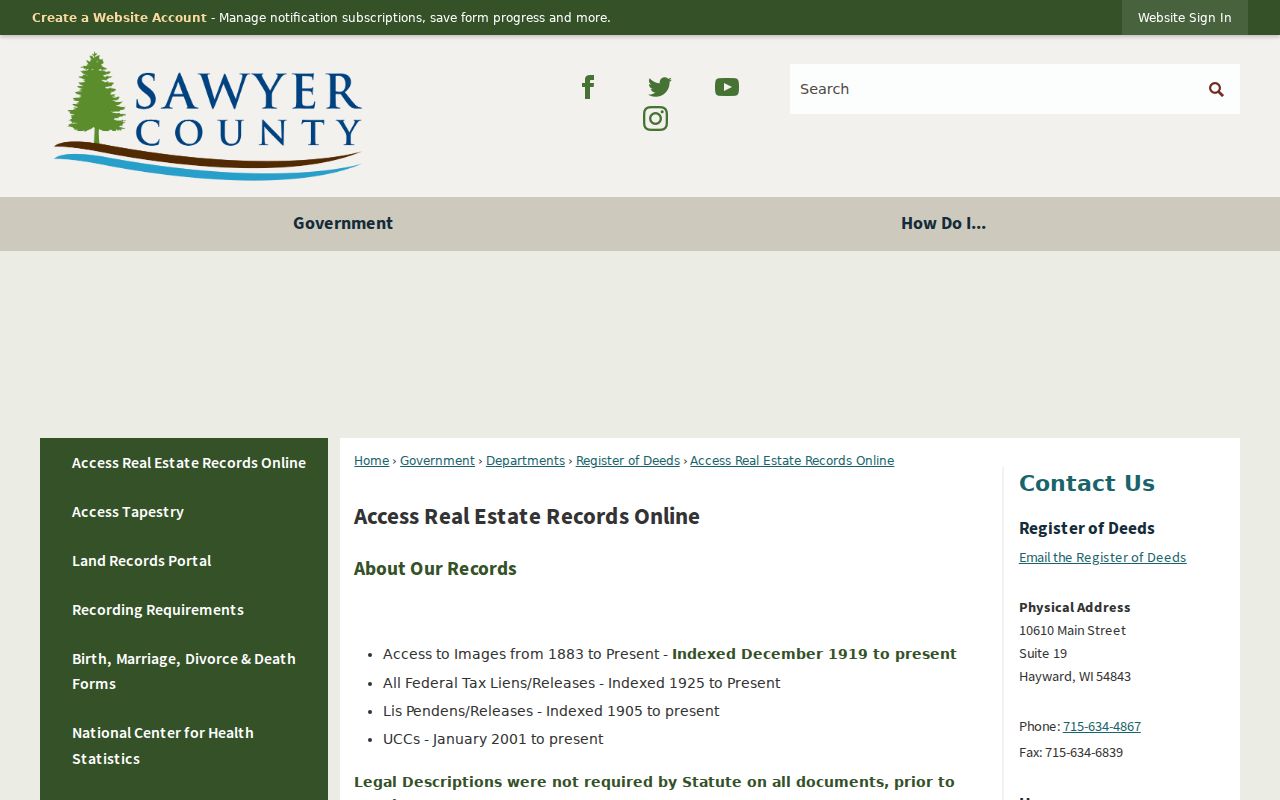
The office page states the coverage split and access routes.
Tapestry or Laredo for Sawyer County Deeds
Fidlar Tapestry serves occasional users in Sawyer County. The county lists $6.95 per search. Each image page adds $1. Laredo, the frequent-user path, requires an Internet Access Agreement plus a Laredo Agreement. The fee schedule lists separate public and external-user terms. Frequent researchers should confirm current amounts and account requirements with the Register of Deeds.
The live Fidlar form sits behind payment or login. Common search concepts include grantor, grantee, document number, recording date, document type, and parcel or legal-description cross-reference. Exact labels, required flags, and sort order vary, so do not assume every clue is a searchable field in the current interface. Open the official Tapestry entry for Sawyer County before a paid search.
The Tapestry gateway image pairs with the county coverage page's Laredo route.
Search Clues in a Sawyer County Deed
Start with what a known instrument shows. A document number can pull one deed straight away. Grantor and grantee names point to the parties on a transfer. Add the recording date or document type only when it is known, then compare the image with the legal description and parcel ID. The portal does not publish exact field labels.
| Grantor | The party shown as transferring an interest. |
|---|---|
| Grantee | The party shown as receiving an interest. |
| Instrument number | The county's recorded-document reference, when known. |
| Legal description | The land description to compare with a parcel or survey. |
Names may appear with initials, spelling variants, trustees, or estates. Business entities complicate things too. An entity's registered agent is not the property's owner of record, and a close match with a different parcel description may involve another tract with a similar address.
Following Sawyer County's Grantor-Grantee Chain
Work backward through the chain. Start with a deed naming the current grantee. Then search that deed's grantor as a grantee in the earlier transaction, since each owner normally received the land from someone else. Sawyer County's online name index stops at December 1919. Older links may need deed-book references and guidance from the Register of Deeds office.
- Find the latest deed in which the present owner appears as grantee.
- Read the grantor name, recording reference, date, and legal description from the image.
- Search that grantor as a grantee to locate the deed by which they acquired the same land.
- Repeat until the search reaches the needed date, then ask the Register about pre-index books.
- Grantor
- The party named as making the transfer.
- Grantee
- The party named as receiving the transferred interest.
- Chain of title
- The ordered series of recorded transfers for the land.
- Instrument number
- A recorded-document reference; compare it with any book or page cited on an older record.
What Sawyer County Requires to Record
Sawyer County will not record a deed that arrives incomplete. Every document needs a full legal description. It also needs the 12-digit legacy parcel number, a return address, and the drafter's name. The first page must leave a blank three-by-three-inch space in its upper-right corner. Names should be typed. Grantor and grantee roles must stay clear, and a notarized signature backs each one. A certified survey map carries its own references: lot, document, CSM, and volume/page.
Give the instrument a readable title so indexers enter the parties consistently. Check the return-to address, the Wisconsin transfer receipt, and each CSM reference before submission. One exception applies to older recordings. Some instruments were recorded before March 1, 1992. Sawyer County did not require a complete legal description on the face of those documents. That gap is why an older deed image sometimes needs pairing with a plat or survey. Only then is the land clear.
The county checklist folds in Wisconsin's electronic transfer receipt rules. Same-day processing stops at 3 p.m. under county code. Even so, the counter stays open until 4. Fees vary by document type. The schedule lists $30 for a real-estate document and $50 for a plat. Amounts can change, so confirm before paying. Review the current recording requirements before bringing a deed in.
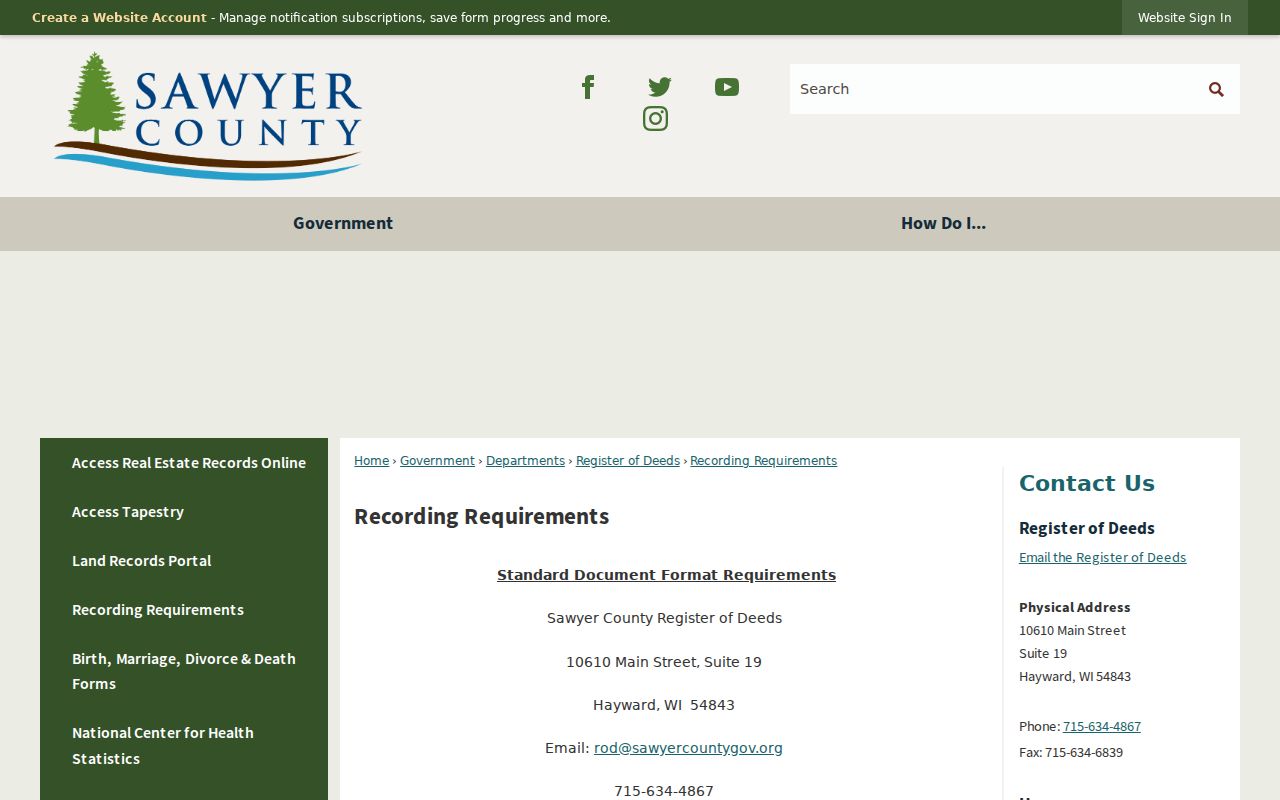
The checklist turns the parcel ID and first-page layout into concrete steps. A clerk can confirm whether a specific instrument meets today's standards.
When a Sawyer County Image Is Office-Only
Not every Sawyer County document lives online. A county notice for instrument 201448 explains the situation. An item with no Tapestry result may be available only from the Register of Deeds. The notice routes readers to the office. It warns against reading a paid portal's empty result as a missing document. It lists no grantor, grantee, document type, or recording date. Treat it as a pointer, not a sample deed record.
When asking staff for help, come prepared. Bring a known instrument number, a date, a name, or a parcel clue. Sawyer's Register sits at 10610 Main Street, Suite 19 in Hayward. Call 715-634-4867 during weekday office hours, 8 a.m. to 4 p.m. The county notice about document 201448 shows that offline access is a real fallback. It matters when the portal comes up empty.
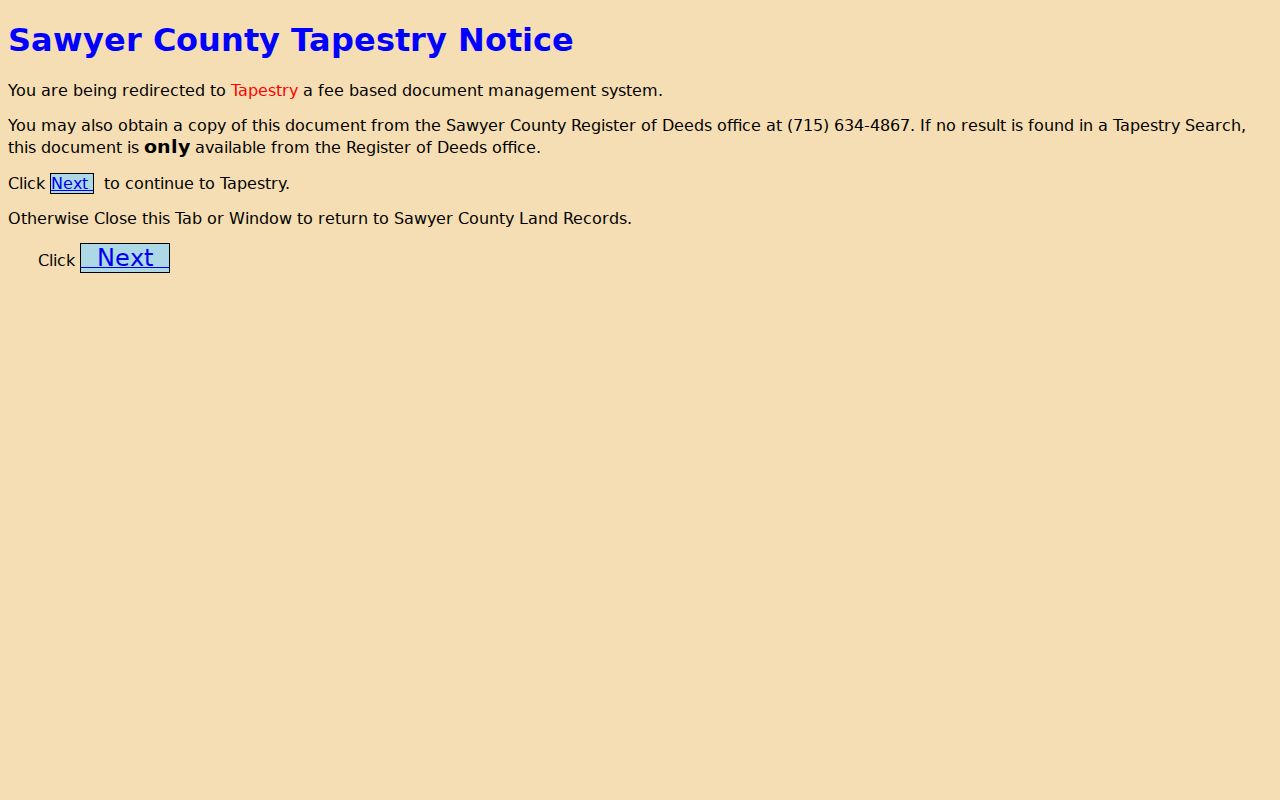
For this notice, the office itself is the next step whenever Tapestry does not return the image.
Sawyer County Liens, Releases, and Plats
A deed search covers only part of the recorded land file. Sawyer County's Register indexes lis pendens and releases from 1905. Federal tax liens and releases go back to 1925. UCC filings date from January 2001. Mortgages, assignments, satisfactions, easements, restrictions, plats, and certified survey maps can all attach to the same parcel. Together they fill out a property's paper history.
A recorded lien deserves a second look. Search for the later release or satisfaction rather than assuming the burden is still open. A lis pendens signals litigation. Compare the case number in WCCA and request the full docket from the Clerk of Court. For a land division, match the recorded plat or survey to the legal description. A GIS map helps show the parcel's shape, but the filed instrument remains the authority.
Obtaining a Sawyer County Deed Image or Copy
Casual researchers can pull deeds through Tapestry, which charges $6.95 per search plus $1 for every image page. Heavier users should ask about a Laredo subscription or stop at the Register of Deeds counter, open weekdays from 8 a.m. to 4 p.m. Real-estate copies run $2 for the first page and $1 for each page after, with a $1 stamp on certified copies. Recording fees are $30 for a new real-estate document and $50 for a plat. Always confirm the current fee schedule before you pay.
Bring the right details and staff can find the deed fast. Give them the parcel number, the grantor and grantee names, an approximate recording date, and the legal description if you have it. The office sits at 10610 Main Street, Suite 19, in Hayward, WI 54843, and the phone number is 715-634-4867. For title chains reaching before December 1919, ask staff about the older deed books and indexes.
Recorded, not guaranteed. The Sawyer County deed index shows instruments in its records; it is not a title opinion, and an unrecorded interest may not appear. A title company or attorney evaluates the legal chain.